Defensive system
The defensive wall around the settlement was the first thing to be built at this site and, therefore, conditioned subsequently not only the urban design of the habitat but also the perimeter layout of the houses, which from the settlement’s earliest days were adjoined at the rear to its internal face. The archaeological excavation has unearthed 40 linear metres of wall; along its entire length, it has a very regular width which ranges from 150 to 160 cm. The wall was constructed with two good quality sandstone faces: faced, dry-laid ashlar, sometimes using large intercalated blocks over a metre wide; the core was filled with a matrix of compacted shapeless stones resulting from cutting the ashlar blocks. Calculations of the minimum slope that the roofs of the houses could have had where they met the wall indicate that this fortification may have been 4 to 5 metres high. It was probably topped by a wooden palisade which could accommodate a walkway inside it.
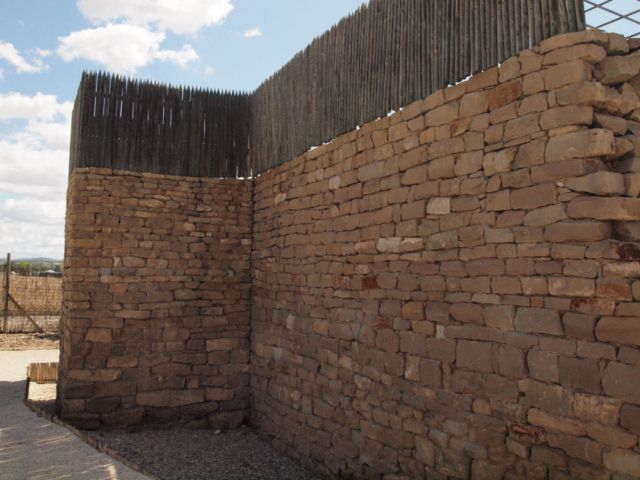
This defensive enclosure was completed with quadrangular towers on the outer face of the wall, probably equidistant all along the perimeter. Two, 28 metres apart, have been discovered in the excavation area. They were built using the same materials and bonding as the defensive wall: an exterior face three metres wide made of faced blocks and compacted dry fill.
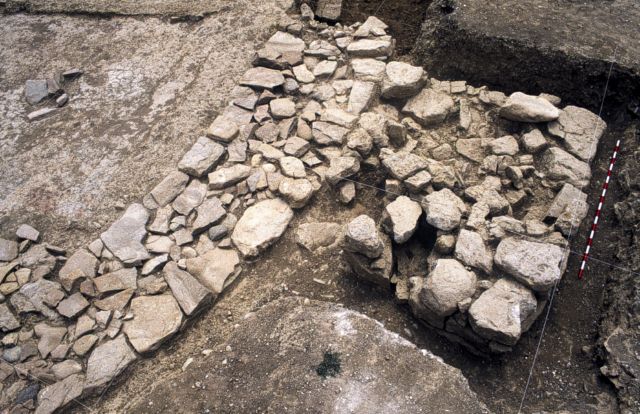
The tower wall at Las Eretas in Berbinzana, which undoubtedly made actively defending the village easier by permitting flanking fire on the enemy, can be compared in terms of both form and age to the fortress of “Els Vilars D´Arbeca” (Lleida), which is slightly older. At Las Eretas, however, the existence of the exterior siege-defence systems usually deployed in front of tower walls, such as moats and fields of upright stones (chevaux de frise), has yet to be documented. Given that the village is located on an alluvial plain, there can be little doubt that such defences will quite quickly become apparent if and when excavation extends beyond the wall.