Evolution over time
Foundation of the first settlement. Freestanding dwellings made of branches and mud
The first dwellings were erected at Las Eretas in the 7th century BC when the stone wall and pebbled street had already been built. They had a rectangular floor plan and a hearth in the middle but were very fragile because they were only held up by small ash posts driven into the ground in lines to bear woven branches plastered with mud. They probably had gabled roofs running lengthwise because there were open passages between houses to access the wall. We know that this founding settlement was destroyed by fire, but we do not know if it was accidental or intentional.
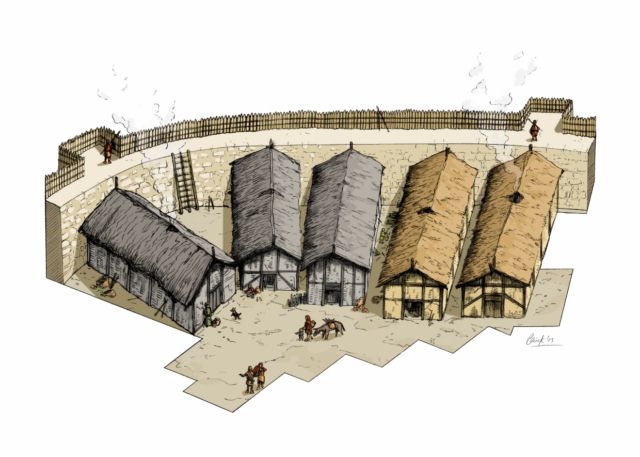
Second settlement. Adjoining houses in stone and adobe.
On the ashes of this first fortified settlement, the peasants living there built a more compact and resistant village. The new houses shared load-bearing dividing walls and were built on top of a dry-laid stone base (either limestone taken from the quarries located not too far away or cobbles collected from the riverbed of the nearby Arga river). The walls were made of adobe or rammed earth, and the roof – forming a single slope from the defensive wall to the street– was made of wood, straw and earth. This roof was divided into three sections, separated by two crossbeams which rested on the load-bearing walls at the sides of the dwelling and two central posts which have left their mark on the ground.
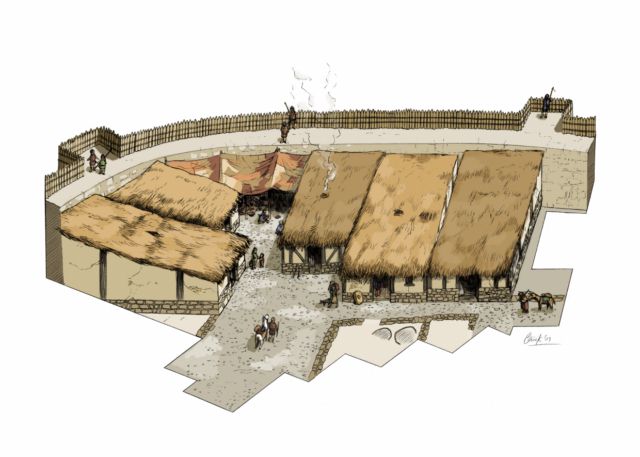
Urban remodelling. The bakery.
Life went on in this second settlement from the 6th to the 5th century BC without any major changes to its layout, although probably due to a small fire, the western part was redesigned and the arrangement of the houses was altered, which meant that it was possible to build a bakery up against the defensive wall for collective bread production. Two ovens, a fireplace and several shelves on which the grain could be ground and the bread dough prepared have been discovered.
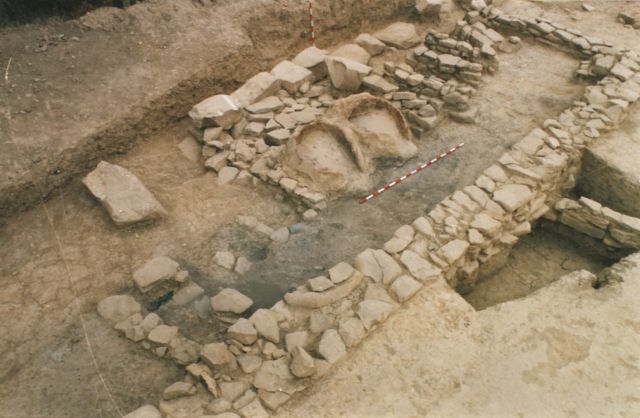
Celtiberian village. Population growth meant that the defensive wall had to be brought down.
The investigations carried out inform us that at some point between the 4th and 3rd centuries BC, the village was no longer large enough and so the wall was demolished to allow it to expand westwards. It was this new village which was paved with the stone cobbles, but we have little idea of the layout of the houses because the archaeological layers have only been partially preserved due to their proximity to the surface.
The village of Las Eretas is romanised.
We know that this habitat was inhabited until the 1st century BC because a destruction layer which can be dated back to the beginning of that century has been discovered. The layer may be related to the Sertorian war, since many other villages in the region have destruction and abandonment layers corresponding to that time. Some time after this conflict, a new village, or vicus, was built in Berbinzana, not at this location, however, but a little further north, where abundant archaeological remains have been collected. From the time of Emperor Constantine (4th century AD) dates a milestone on the Roman road through the Arga valley which connected Graccurris (Alfaro) with Andelo (Andión, Mendigorría) and Pompelo (Pamplona).