The houses
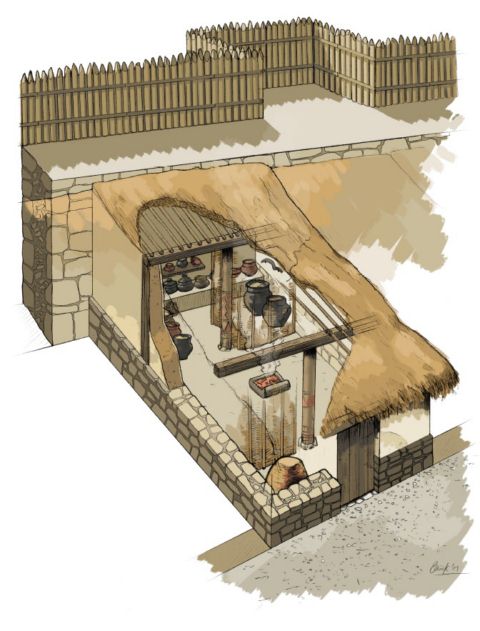
Although only four houses have been excavated in their entirety and the same number partially, they all share the same floor plan (rectangular with a door opening onto the street on the narrower front end and attached to the defensive wall at the back) and similar internal compartmentalisation. It is, however, also true that there are notable constructive differences between the short-lived dwellings at the lower level of the village, which were made of ‘posts and branches, and plastered with mud’, and those built on top, when the earlier ones had deteriorated, with ‘stone bases and adobe elevations’. The earlier dwellings had flimsy structures consisting of small posts made of ash wood set out a short distance apart that held up woven branches which were then coated with mud. They probably had gabled roofs and there were open passageways between the dwellings. The later houses, however, shared load-bearing walls which ran lengthwise and consisted of a masonry base made of stone and bone with adobe walls and thatched roofs which sloped from the defensive wall down to the street, divided into three separate sections by two crossbeams which rested on the load-bearing walls on the sides of the building and central posts which have left their mark on the ground.
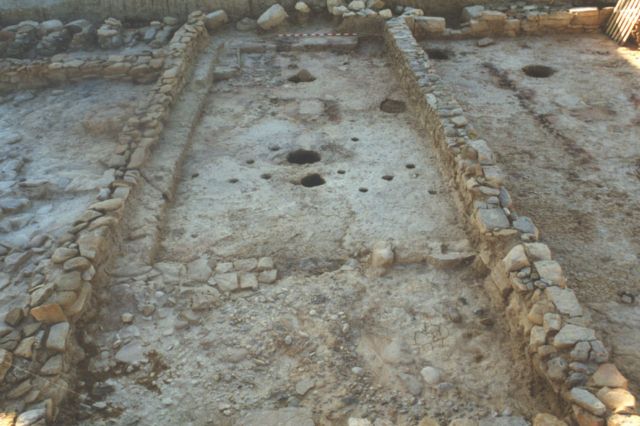
As for their internal structure, they basically followed the three-section division on the ground floor taken as the norm since the excavation at Alto de la Cruz in Cortes, Navarre: an entrance area behind the door, where it was common to find the oven; a central room, the main part of the dwelling, which revolved around the hearth, a rectangular plate of refractory clay with moulding on the side facing the door to divert the air draught, and, finally, at the back of the dwelling, a pantry, with painted rammed-earth benches forming an angle along the wall. Although the archaeological record does not corroborate the fact, the indented marks on the ground left by post bases seem to show, or at least suggest, that at the back of the dwelling there may have been a storage loft for materials and food right where the single-slope roof met the defensive wall. Conceivably, it was also possible to access the walkway on the defensive wall from this loft with the speed and ease required in the event of attack or danger to repel the enemy.